Please regard this as a "work in progress". I welcome any comments. I am particularly interested if anyone can supply more details on some of the reed types.
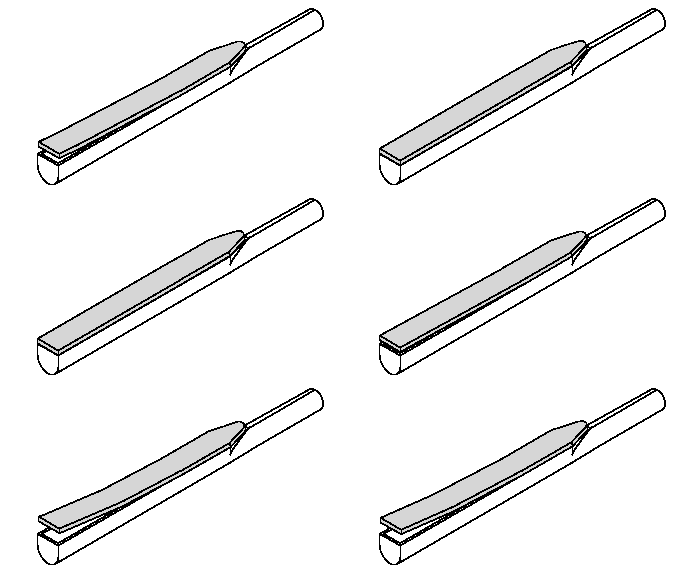
The reeds used in the drones of the Northumbrian Smallpipes are single-beating. They have a flexible tongue which vibrates against a relatively rigid body.
There is no reason to believe that any of the above forms is inherently superior to the others. Each have their advantages and drawbacks.
I will attempt to list some of the desirable properties in a drone reed:
Perversely, the quality which, in the final analysis is the most important is placed last in the list, but there is no point addressing this final, critical, aesthetic point until the earlier 'mechanical' points are resolved and we have a 'reliable' reed.
In determining the effective pitch of a drone reed, the two major factors are the stiffness of the 'hinge' and the moment of inertia of the blade. The moment of inertia is a combination of the weight of the blade and the distance from the 'hinge' to the centre of gravity. i.e. a combination of weight and length. The moment of inertia increases proportionately with the thickness, while the stiffness increases as the square of the thickness. Thus, doubling the thickness of the blade will increase the moment of inertia by a factor of 2 which would halve the pitch of the reed. On the other hand this would also increase the stiffness by a factor of 4 which would quadruple the pitch of the reed. Combining the two means that, other things being equal, doubling the thickness of a reed blade increases its pitch by a factor of two. Of course, when these reeds are fitted into a drone, the effect is nowhere near as great as this factor of two.
The minimum length of a drone determines the the highest possible pitch which the drone can produce. Any reed which works will produce a pitch lower than this maximum. In my opinion, it is better to produce a reed which is sharper than required and then flatten it either by adding weight to the end of the tongue or by scraping the hinge area to reduce the stiffness of the blade. If this is overdone, the pitch can be raised by adding more wrapping. I do not think that adjusting the wrapping is a good way to make substantial pitch adjustments as this will change the aspect ratio (length/width) of the reed which I am sure will have tone implications which are hard to predict.
I will, at some time, include the dimensions of drone reeds I am using at the moment.
Barry Say, 14th Feb 2007.Send me your comments